
DevelopingForeignTimeline
Canada–E.U. Associate Membership Plan
Updated 1 updatesince 66 outlets
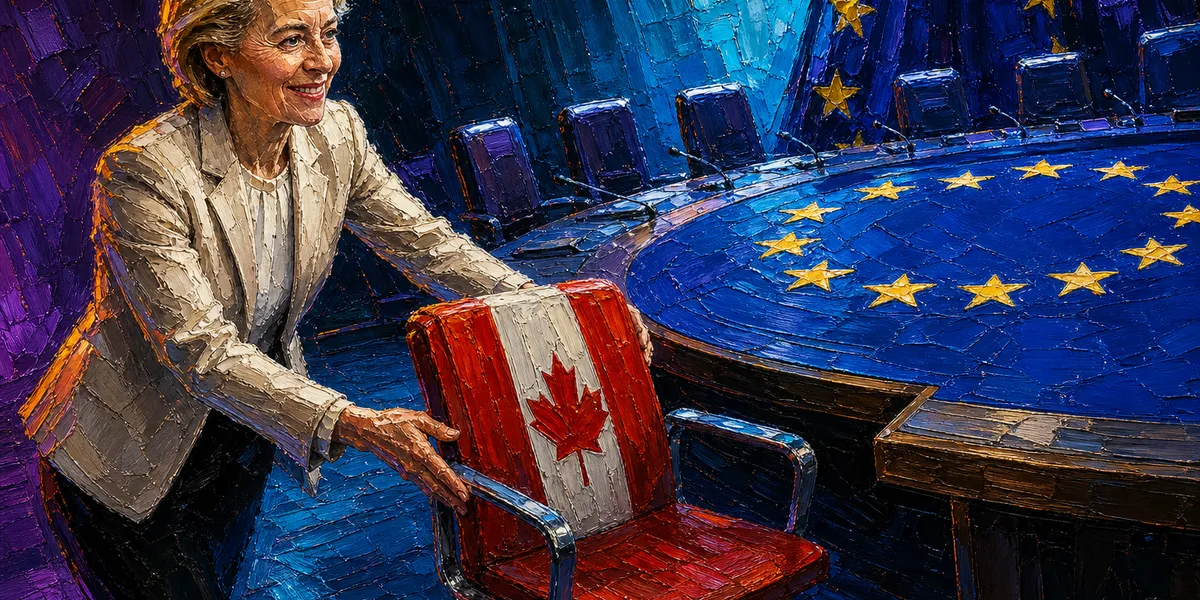
The Canada–E.U. Associate Membership Plan centers on a proposal by European Commission President Ursula von der Leyen to grant Canada unprecedented 'associate member' status, aimed at enhancing cooperation across various sectors.
Timeline
Now
In her State of the Union speech on September 16, 2026, European Commission President Ursula von der Leyen proposed that Canada become the EU's first 'associate member'. This unprecedented status aims to deepen cooperation between the EU and Canada in areas such as technology, defense, and critical minerals, amidst…
66 sources · Reuters, New York Times
- Origin Sep 16, 2026
The story so far
As of September 16, 2026
European Commission President Ursula von der Leyen used her State of the Union speech to invite Canada to become the European Union’s first associate member, with Prime Minister Mark Carney in the chamber and receiving a standing ovation. The category does not exist in current EU treaties. She framed it as an “alliance for the future” that would take the relationship beyond trade to joint work on technology, defense, energy, critical minerals, batteries and the Arctic.
What this has become is a test of whether the EU can build a new outer circle for close partners without calling it enlargement. The shape is undefined and would need all 27 governments to agree. Capitals have resisted such flexible statuses before, and earlier talk of an associate track for Ukraine met pushback. That explains why the label is contested even as the strategic intent is clear.
The stake is practical: giving Europe and Canada a structured way to link defense industries, secure supplies of key minerals and batteries, and coordinate on AI and cyber security as Europe tries to cut one-way dependencies on China and lower energy risk. Von der Leyen also floated a European Security Council that would bring in the UK, Norway, Ukraine and others, placing Canada inside a wider security format. The through line is a shift from a trade-first relationship to shared industrial and security planning.
Where it stands now is early stage. Canada says it is not seeking EU membership and that the name and terms are still to be set, with Carney due to address the European Parliament. Member states must decide whether to pick up the idea, and the Commission would have to design a legal path that fits today’s treaties or agree changes. The next check on momentum is whether capitals back a concrete mandate before the EU-Canada summit in Montreal next month.
Each entry is synthesized by AI from the reports linked on it, and labeled with the kind of change it represents. How Frameshift works · What the labels mean · Report an error
In the app
Read this timeline in Frameshift
Four stories are free on the web. The full Vault, with every timeline and brief, is in the app.