
DevelopingForeignTimeline
China–Egypt State Visit
Updated 3 updatessince 42 outlets
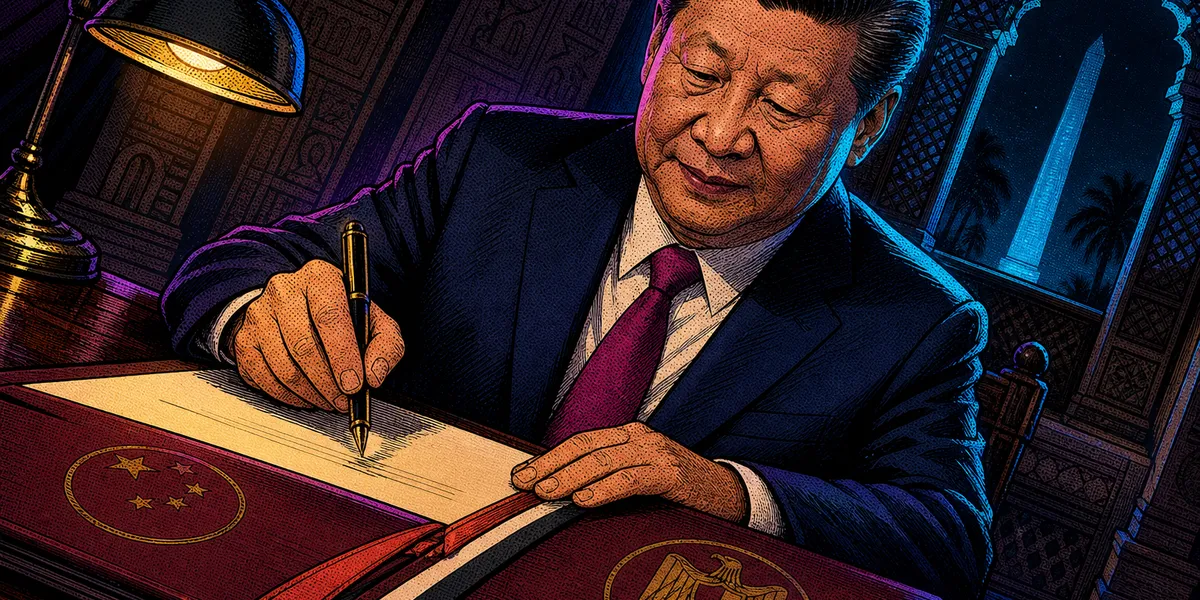
Chinese President Xi Jinping's visit to Egypt from August 30 to September 3, 2026, commemorates 70 years of diplomatic relations and includes significant discussions with President Abdel Fattah El-Sisi.
Timeline
Now
Xi Jinping Signs Agreements With Egypt
EscalationChinese President Xi Jinping held talks with Egyptian President Abdel Fattah El-Sisi during his first visit to Egypt in ten years.
13 sources · جريدة الأهرام, Latest Asian
Chinese President Xi Jinping engaged in extensive discussions with Egyptian President Abdel Fattah El-Sisi during his visit, marking the first such engagement in a decade.
22 sources · NPR, Reuters
Chinese President Xi Jinping's upcoming state visit to Egypt from August 30 to September 3 was confirmed, coinciding with the 70th anniversary of diplomatic ties between the two nations.
15 sources · New York Times, NPR
- Origin Aug 26, 2026
The story so far
As of September 3, 2026
China’s president, Xi Jinping, has made his first visit to Egypt in a decade, meeting President Abdel Fattah El-Sisi and closing with a raft of agreements and a joint statement that elevates the relationship. The trip was tied to 70 years of diplomatic relations and staged with full honors in Cairo, including a 21-gun salute and a museum tour, but the substance sat in what the two sides chose to lock in: money, industry, technology, and security.
Officials said more than 20 cooperation documents were signed. The standouts are financial and industrial. The two governments renewed and enlarged their currency-swap line and agreed to use their own currencies more in trade and investment. Egypt announced an expansion of the Chinese-developed industrial zone along the Suez Canal, where about $4 billion in Chinese investment is already booked, and a preliminary deal to study a $500 million tire plant by ZC Rubber. The joint statement also lists work on data centers, semiconductors and critical metals, and steps toward an extradition treaty and tighter counterterrorism coordination.
Security framing ran through the visit. Xi urged Middle Eastern countries to oppose outside interference and said China is ready to help safeguard shipping. The joint text puts Red Sea security in the hands of the states on its shores and calls for a ceasefire in Gaza, unrestricted aid, and the Palestinian Authority’s return to the strip, while voicing concern over settler violence and settlement growth in the West Bank. On Sudan, both sides backed unity, non-interference, and a Sudanese-led political process. Separately, Egypt publicly reiterated its support for the One China principle.
What this has become is a bid to bind Cairo and Beijing across finance, supply chains, and security at a moment when shipping through Hormuz and Bab al-Mandeb has been disrupted and the Suez Canal’s role has grown. The currency swap and local-currency push reduce exposure to the dollar system; the Suez industrial build-out anchors Chinese manufacturing and logistics on a vital trade artery; and the security language signals how both want the rules around the Red Sea and Gaza set. Egypt is still hedging, flying French Rafales in August drills even as Chinese J‑16s joined, and remaining a top U.S. defense partner, but the facts that now explain the rest are the enlarged swap line, the Suez zone expansion, the technology and metals clauses, and Cairo’s explicit political alignment on One China.
Each entry is synthesized by AI from the reports linked on it, and labeled with the kind of change it represents. How Frameshift works · What the labels mean · Report an error
In the app
Read this timeline in Frameshift
Four stories are free on the web. The full Vault, with every timeline and brief, is in the app.