
DeadForeignTimeline
Greenland Standoff
Updated 27 updatessince 88 outlets
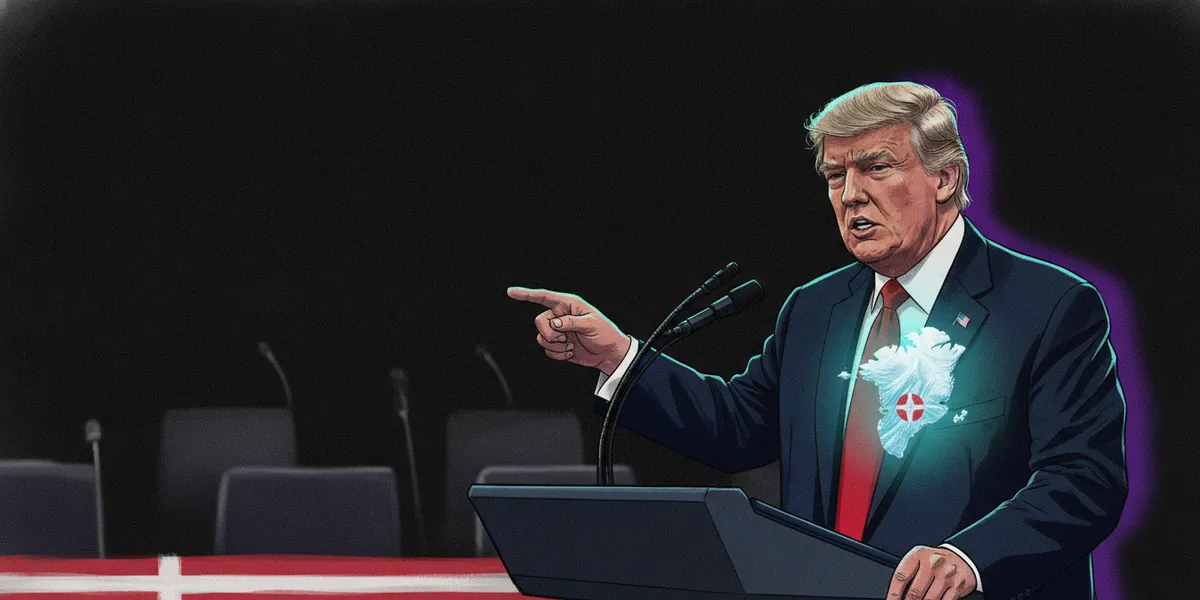
The U.S.-Denmark-Greenland standoff revolves around tensions over U.S. claims to Greenland, heightened by President Trump's rhetoric and imposed sanctions. As of now, Greenland's leadership asserts its sovereignty amid ongoing discussions.
Timeline
Now
No New Updates on Greenland
New FactsToday's news coverage concentrated on President Donald Trump's decision to fly back using the older Air Force One instead of discussing his previously stated demands regarding Greenland.
5 sources · Reuters, New York Times
During the NATO summit held in Ankara, Turkey, President Donald Trump publicly declared that Greenland should be controlled by the United States rather than Denmark, marking a significant increase in his rhetoric regarding the territory.
8 sources · BBC, Financial Times
Prediction markets have reported a surge in trading volume related to the potential U.S. acquisition of Greenland during Donald Trump's presidency.
13 sources · Reuters, Bloomberg
Greenland Prime Minister Jens-Frederik Nielsen stated that he had a productive meeting with U.S. special envoy Jeff Landry while reiterating that Greenland is not for sale and the islanders have the right to self-determination.
3 sources · Reuters, Washington Post
Trump's ambitions regarding Greenland are now being scrutinized for their implications on U.S. Arctic security.
4 sources · Reuters, The Guardian
Denmark is facing a national election on March 24, 2026, with the ongoing dispute with Donald Trump over Greenland overshadowing the political landscape. The escalating tensions between the U.S.
3 sources · Reuters, Washington Post
Greenland Push Spurs Self-Rule Movement
EscalationTrump's aggressive efforts to acquire Greenland have intensified discussions about the island's long-standing aspirations for self-determination.
2 sources · CNBC, CNN
No New Developments on Greenland
New FactsToday's coverage reported no new developments related to Donald Trump's Greenland demands amidst ongoing discussions about U.S. military action in Iran and falling approval ratings for Trump on economic issues
9 sources · New York Times, Reuters
Donald Trump's pursuit of Greenland traces back to an intelligence briefing in early 2018, connected to concerns over rising Russian submarine activity, according to a report by Time.
4 sources · The Hill, Time
Arctic Security Becomes Central Issue
EscalationToday's article emphasized that Arctic security is emerging as a significant political issue, spurred by Trump's persistent assertions regarding Greenland.
10 sources · New York Times, Axios
US Reveals Greenland Deal Details
De-escalationGov. Jeff Landry, the U.S. special envoy to Greenland, shared key details about a diplomatic deal that seeks to de-escalate tensions between the United States and Europe regarding Greenland.
7 sources · New York Times, Reuters
On January 25, 2026, President Donald Trump announced a 10% tariff effective February 1 on goods from Denmark and seven other European countries as tensions escalated over Greenland.
9 sources · Washington Post, Bloomberg
Donald Trump moderated his stance on Greenland at the World Economic Forum in Davos, moving away from his earlier demand for direct acquisition.
8 sources · AP, New York Times
Trump Demands Immediate Greenland Negotiations
De-escalationDonald Trump announced during a recent press briefing that he is seeking 'immediate negotiations' for the acquisition of Greenland, citing national security interests.
6 sources · NPR, BBC
EU Vows Strong Response to Trump
EscalationEuropean Commission President Ursula von der Leyen addressed the annual World Economic Forum, stating that the EU would respond 'unflinchingly' to U.S. President Donald Trump's threats related to Greenland.
4 sources · Reuters, New York Times
Trump's proposed tariffs on imports related to Greenland could significantly impact the European car industry, disrupting supply chains and investment plans. Analysts warn that this move could escalate tensions between the U.S.
5 sources · BBC, Bloomberg
Scott Bessent, U.S. Treasury Secretary, stated that the need for U.S. control over Greenland arises from European weaknesses that could threaten global stability.
8 sources · Reuters, Wall Street Journal
Bipartisan delegation from the U.S. Congress met with Danish officials in Copenhagen to reinforce that there is not substantial support in Congress for Donald Trump's proposal to acquire Greenland.
4 sources · New York Times, NPR
Danish official stated that there is a 'fundamental disagreement' with President Donald Trump over his Greenland demands.
10 sources · New York Times, Washington Post
Analysts from The Atlantic and USA Today expressed concern over Trump's ambitions regarding Greenland, warning that his fixation could escalate into a global conflict.
6 sources · Reuters, New York Times
Donald Trump threatened US military force to secure Greenland, describing this action as a necessary step for national security.
8 sources · Reuters, New York Times
Trump Proposes Seizing Greenland Again
EscalationDonald Trump reiterated his ambition to seize Greenland during a recent press briefing, citing national security interests.
7 sources · Reuters, New York Times
Donald Trump warned that countries opposing U.S. acquisition of Greenland might face new tariffs, as a bipartisan group of U.S. lawmakers visited Denmark to address the growing tensions.
7 sources · Reuters, BBC
Donald Trump announced the appointment of Louisiana Governor Jeff Landry as the U.S. special envoy to Greenland.
6 sources · AP, BBC
France and Germany confirmed they will send troops to Greenland as part of a European security mission following the renewed threats made by President Donald Trump.
7 sources · BBC, Washington Post
Denmark's foreign minister summoned the top U.S. diplomat following reports that individuals associated with Donald Trump were allegedly involved in covert operations aimed at influencing Greenlandic society.
4 sources · Reuters, AP
President Trump announced plans to impose sanctions on nations deploying military forces to Greenland, heightening tensions with European allies. This move was linked to a perceived snub by the Nobel Peace Prize committee.
10 sources · New York Times, Reuters
- Origin Jun 3, 2025
The story so far
As of July 8, 2026
The U.S.–Denmark–Greenland standoff is now an alliance test, not a thought experiment. Washington is trying to convert Arctic access and defense priorities into authority over the world’s largest island, while Copenhagen and Nuuk frame the question around sovereignty and the right of Greenlanders to decide their own status. What is at stake are the rules that govern territorial change, the credibility of self‑determination inside a European kingdom, and whether NATO can absorb coercive pressure among its own members without splintering its Arctic posture.
The hinge moment came at the NATO summit in Ankara, where President Trump said Greenland should be under U.S. control and Denmark’s prime minister vowed to defend Greenland. The White House then paired the demand with economic and military leverage, threatening a 10 percent tariff on eight European countries, ordering a cutoff of all U.S. trade with Spain, and raising the prospect of withdrawing U.S. troops from Italy and Spain. Markets reacted as a proxy scoreboard, with European shares logging their sharpest drop in two months and gold and silver jumping to records on the Greenland tariff threat. Those moves define the dispute as a test of will inside the alliance rather than a bilateral property negotiation.
Allies have answered with position, not rhetoric. NATO nations moved forces to Greenland after tense White House talks, and European troops arrived on the island as Steadfast Dart 2026 unfolded, signaling that the status quo will be physically maintained. In parallel, Denmark summoned the U.S. ambassador over alleged influence operations in Greenland, even as the administration weighed payments aimed at swaying public opinion there. The U.S. named Louisiana governor Jeff Landry as special envoy; he traveled to meet Greenland’s leadership, but the island’s prime minister, Jens‑Frederik Nielsen, has repeated that Greenland is not for sale and any decision rests with Greenlanders.
Where it stands is simple and hard: there is no deal between Washington and Copenhagen, and a new Danish government says it will stand firm. The facts that explain the rest are a triad of leverage, law, and hard power. U.S. tariff and troop threats are meant to force movement; European deployments and a united political line raise the cost of any unilateral change; Greenland’s legal status inside the Kingdom of Denmark gives Greenlanders an effective veto over transfer. Until one of those pillars shifts, the standoff remains a live stress test of NATO cohesion and Arctic security with no agreed pathway to resolution.
Each entry is synthesized by AI from the reports linked on it, and labeled with the kind of change it represents. How Frameshift works · What the labels mean · Report an error
In the app
Read this timeline in Frameshift
Four stories are free on the web. The full Vault, with every timeline and brief, is in the app.