
DevelopingPoliticsTimeline
Maryland Redistricting Ballot Fight
Updated 1 updatesince 3 outlets
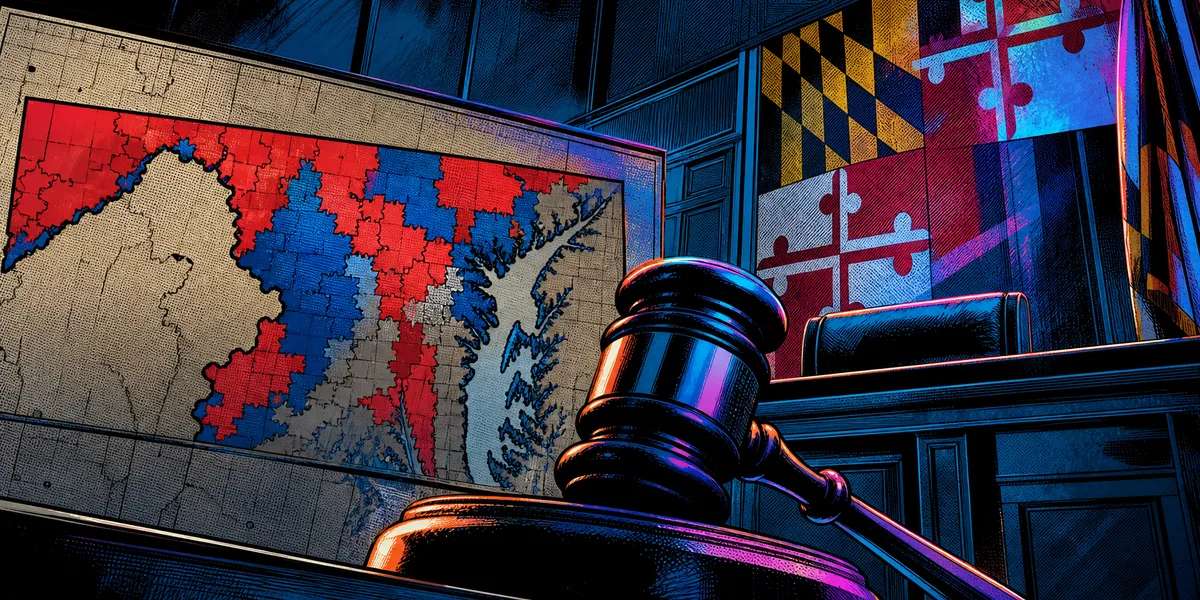
The saga centers on a legal challenge regarding a proposed constitutional amendment for congressional redistricting in Maryland, with a recent ruling blocking its inclusion on the November ballot.
Timeline
Now
Judge Robert Thompson issued a ruling on August 26, 2026, preventing a constitutional amendment regarding congressional redistricting from appearing on Maryland's November ballot.
3 sources · ArcaMax, The Baltimore Sun
- Origin Aug 26, 2026
The story so far
As of August 26, 2026
A Maryland trial judge has blocked a proposed constitutional amendment on congressional redistricting from appearing on the November ballot, finding lawmakers broke state election law when they advanced it in a special session and bundled more than one change into a single question. Judge Robert Thompson’s order tells the State Board of Elections not to include the measure, labeled Question 3, on the Nov. 3 ballot. He put his ruling on hold while the state appeals to the Supreme Court of Maryland, with election officials facing an Aug. 31 deadline to lock ballots for printing.
What the measure tries to do explains the fight over how it got there. It would switch how future congressional maps are judged, substituting federal standards for the standards in Maryland’s constitution, and it would also give the state’s highest court the power to hear redistricting cases first, rather than only on appeal. That pairing is why the judge said it improperly combined separate issues. The content matters because it would shape both the rules and the courtroom for the next map starting in 2028, not the 2026 elections.
The road to court was fast. The Democratic‑controlled General Assembly approved the amendment in a special session earlier this month with the required three‑fifths vote, 96–38 in the House and 32–13 in the Senate, and the governor signed to place it on the ballot. Opponents, including a conservative advocacy group and Republican lawmakers, sued, pointing to a July 1 statutory deadline for finalizing ballot questions and limited time for public input. The state argued that the legislature’s constitutional power to propose amendments lets it override deadlines set in ordinary law. The judge rejected that view and said the process fell short.
What is at stake now is whether voters will see the question at all. The Supreme Court of Maryland is expected to move quickly because of the printing cutoff. If the stay remains and the high court reverses the trial judge in time, Question 3 can be printed on the ballot. If the ruling stands or the clock runs out, voters will not weigh in this fall, and the current state standards and court routes will continue to govern the next round of redistricting litigation.
Each entry is synthesized by AI from the reports linked on it, and labeled with the kind of change it represents. How Frameshift works · What the labels mean · Report an error
In the app
Read this timeline in Frameshift
Four stories are free on the web. The full Vault, with every timeline and brief, is in the app.