
DevelopingCrisisTimeline
Spain's 2026 Train Crashes
Updated 7 updatessince 129 outlets
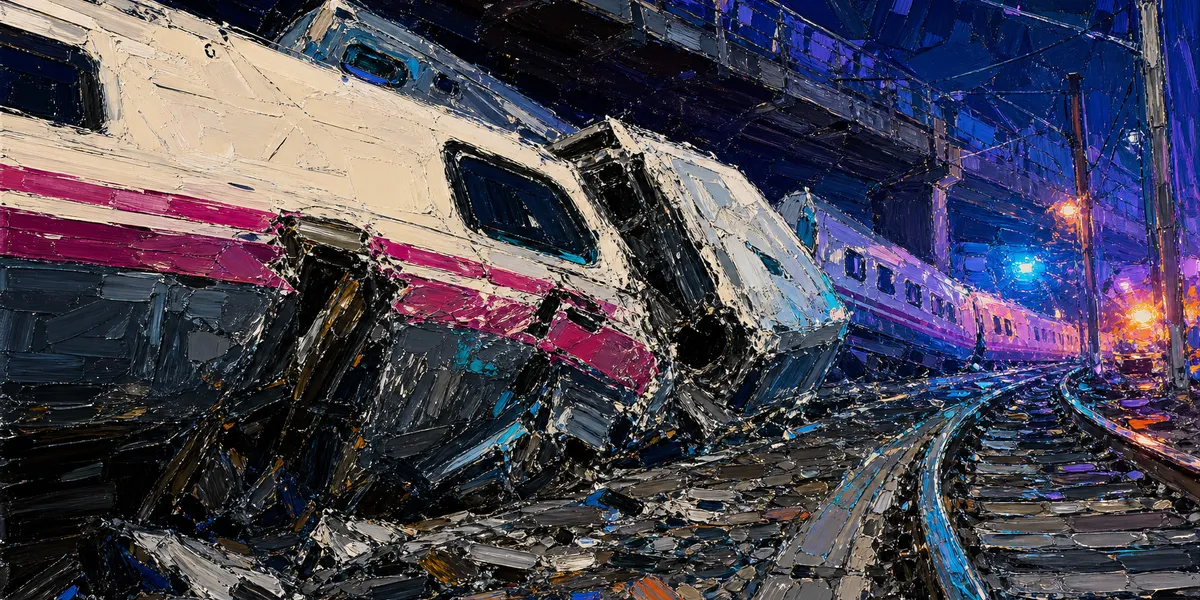
The 2026 Spain train crash saga centers on tragic collisions involving high-speed trains, with the latest incident near Urda resulting in at least 68 deaths. Investigations are examining possible human error as a contributing factor.
Open questions
- Does Pedro Sanchez sack rail chiefs, or risk owning this tragedy?
- Was the technician scapegoated, or did Renfe’s systems truly fail?
- Will Semaf escalate strikes, or partner on real safety fixes?
Timeline
Now
On October 28, 2026, a high-speed train collision occurred near Urda, Toledo, involving a Renfe train that rear-ended a stationary Iryo train, resulting in at least 68 confirmed deaths and over 100 injuries.
21 sources · New York Times, Reuters
Spanish Prime Minister Pedro Sanchez announced three days of national mourning following the high-speed train collision in Toledo province that resulted in at least 68 fatalities.
17 sources · CBS News, CNN
Investigators are now focusing on human error as a likely cause of the train collision near Urda, with reports indicating that a technician failed to alert the Iryo express train of a warning prior to the crash.
18 sources · Reuters, BBC
High-speed train collided with another that had stopped on the tracks near Urda, Toledo province, on Wednesday, leading to at least 68 deaths and over 100 injuries.
40 sources · CNN International, The Philadelphia Inquirer
Train services throughout Spain were significantly disrupted on February 9, 2026, as drivers began a three-day nationwide strike led by the union Semaf.
5 sources · Bloomberg, Reuters
Semaf calls three-day nationwide strike
EscalationSpain's largest train drivers' union, Semaf, announced a three-day nationwide strike scheduled for February 9-11 in response to the deadly train collisions this week that killed at least 46 people.
24 sources · BBC, Reuters
On January 19, authorities confirmed that the death toll from the high-speed train collision near Adamuz rose to 43, as emergency services continued their search for bodies among the wreckage.
39 sources · New York Times, PBS
- Origin Jan 19, 2026
The story so far
As of October 28, 2026
A Renfe high‑speed train rear‑ended a stopped Iryo service on the Madrid–Seville line near Urda in Toledo province, killing at least 68 people and injuring more than 100. Two carriages were knocked off an elevated section of track. More than 500 passengers were aboard the two trains. High‑speed service between Madrid and Andalusia is suspended, and Spain has declared three days of national mourning.
The working explanation is a failure of the line’s automated safety system followed by a manual decision that broke protocol. Around 8:30 a.m., the automation crashed and halted several trains across roughly 63 kilometers. Control shifted to a central room in Madrid, which minutes later cleared the Renfe train to continue at normal speed even though a stop signal remained active and an Iryo train was stationary ahead. The collision followed about 25 kilometers later, near kilometer marker 118.
The investigation has zeroed in on what the controllers knew and ordered as they took over from the failed system. Detectives are reconstructing radio and written instructions, cross‑checking them with track occupancy data and the trains’ recorders to fix the timing, the wording of clearances, and the Renfe train’s speed. The controller who issued the clearance has been questioned, while search and victim identification continue at the site and hospitals treat the injured.
This is Spain’s second deadly high‑speed crash this year on the same corridor and involving the same operators, after a January collision near Adamuz that killed 46. That makes this no longer an isolated disaster but a test of how the network handles the moment when automation fails. The pivotal fact is that a train was authorized to run under a red signal without a low‑speed “caution” order. Whether that was a single human lapse or evidence of a broader weakness in manual fallback procedures is what the current inquiry must establish.
Each entry is synthesized by AI from the reports linked on it, and labeled with the kind of change it represents. How Frameshift works · What the labels mean · Report an error
In the app
Read this timeline in Frameshift
Four stories are free on the web. The full Vault, with every timeline and brief, is in the app.